

Ex-Nazis in Germanies
Federal Republic of Germany
It’s a well-known fact that the post-war military of West Germany in a large part consisted of ex-Nazi elite. That elite included both senior intelligence and military officers who served in the National Socialist administration and were members of the Nazi Party. Famous examples include OKH (German High Command) Chief Adolf Heusinger, who after the war became an Inspector General (the highest possible position for a military officer) of the Bundeswehr (armed forces of West Germany) and then a Chairman of NATO Military Committee, and Reinhard Gehlen, a top intelligence officer in Hitler’s administration who in 1956 became a creator of Federal Intelligence Service, the largest special agency in FRG.
Nevertheless, those were usually members of the military and not a political command and many were not fanatic Nazis. Thus many army officers seemed to be in opposition to Nazi regime, trying even to eliminate Hitler. Although multiple Wehrmacht officials tried to oppose NSDAP’s decision making, there were controversial situations involving them participating in war crimes, such as Theodor Oberländer, senior advising officer in Wehrmacht (armed forces of the Third Reich), taking part in the crimes in France and Ukraine, or Field Marshal Erich von Manstein, convicted of war crimes and then released, afterwards serving as a military advisor for Bundeswehr. This illustrates that it is a mistake to view Wehrmacht officers opposing Hitler and then joining West Germany’s government as a politically neutral and innocent community.
Situation with German Democratic Republic
In a contrast with FRG, GDR’s (German Democratic Republic – East Germany) leadership was less dependent on Hitler’s officials and overall majority of the top military administrators and founders of the most important special agencies were either low-ranked deserters who defected from Wehrmacht in the very beginning of the war and ran over to the Soviets or old members of the German Communist Party who maintained good relationship with the Soviet government and actively cooperated with them throughout Nazi era and even lived in Moscow.
Nevertheless, the newly-formed East German government was not without Ex-Nazis. By Nazis, it is implied that those individuals weren’t just conscripted servicemen (which makes up almost all adult male population of the Reich) but the people who at one point made a decision to join the NSDAP or any other organization of this type in the Third Reich and were actively involved in their activities. There were quite a few officials in East Germany that have joined NSDAP and served the Nazi cause before and during the war. Nonetheless, the issue of Nazis in East Germany was not kept in secret and was addressed and discussed, as there was even a legal political party representing the ex-members and servicemen, called National-Democratic Party of Germany (NDPD). When DDR was created there were over 2 million discharged servicemen and members of the NSDAP1. This process of gradual reintegration was initiated by the Soviet Administration and its general purpose was providing individuals, attracted by the Nazi ideals in the past, an opportunity to honestly work towards “securing the unity and democratic development” of Germany. Usually, at first, those individuals were taken as POWs in the Eastern Front by the Soviets. After that, they were usually agreeing to cooperate and then were getting transferred to the so-called “Antifa Schools,” where they were trained and “re-educated.” By the end of the war, they were returning back to Germany and filling up the official positions of recently-formed GDR. Nevertheless, not all the ex-Nazis went through this process. Some managed to diffuse into the communist system and join the government without making those transitioning steps.
In this article, the biography of one such official and political leader will be discussed. The selected official has played a more or less significant role in the early development and reconstruction of East Germany after World War II. He did not go through the Soviet Antifa Schools, avoided any persecution for his past, and managed to build a successful career in the ranks of the nomenclature of the GDR. The ones that went through this “standard procedure” (such people as Vincenz Müller, one of the creators of the DDR’s Military or many other East German officials who have been proved to serve National Socialist cause) are quite well known and have been publicly discussed.
Biography of Hans Bentzien
Hans Bentzien was a senior official in DDR and a high-ranked member of the Socialist Unity Party of Germany, at the pinnacle of his power being a Minister of Culture.
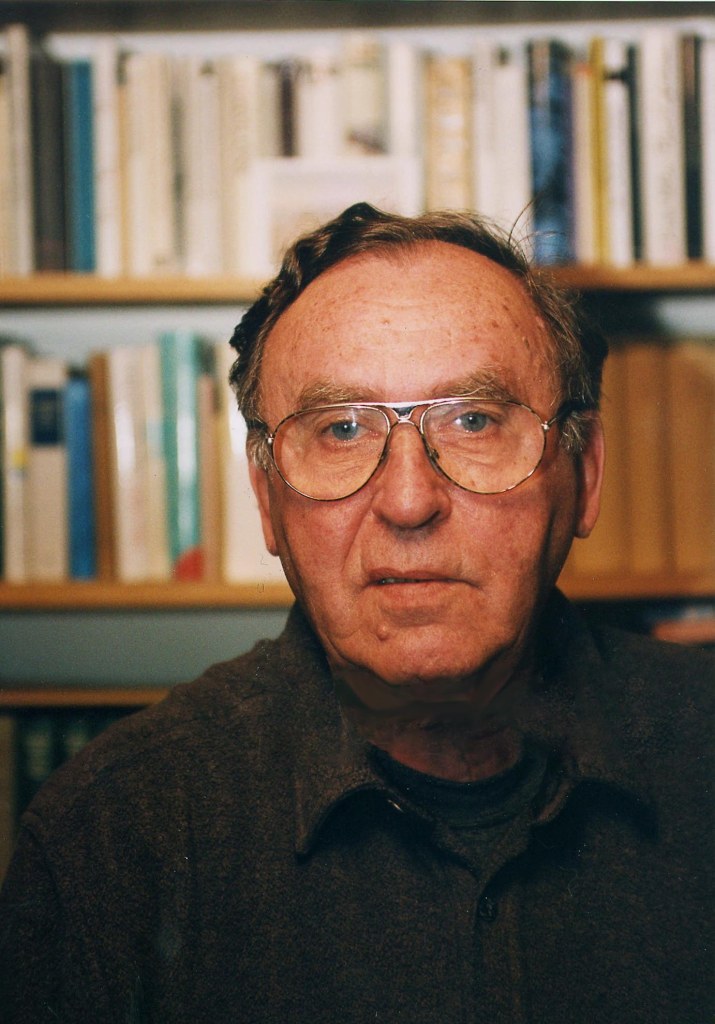
Bentzien was born on January 4th, 1927, in the city of Greifswald of the German Western Pomerania, in a family of a worker. He went to elementary and high school, planning to become a teacher. During the war, at the age of 17 (1944), he joined the Reich Labor Service, an organization dedicated to help the economy during the war through mobilizing young population for work. Same year he joined NSDAP and was drafted to Wehrmacht. According to him, his entry into the Nazi Party was something natural; everyone around him was joining NSDAP without any hesitation, so did he. In any case, he was only 17 by this time, when the war was almost over and couldn’t even possibly take part in any war crime or political action. In 1945, he was imprisoned by the advancing British Army.
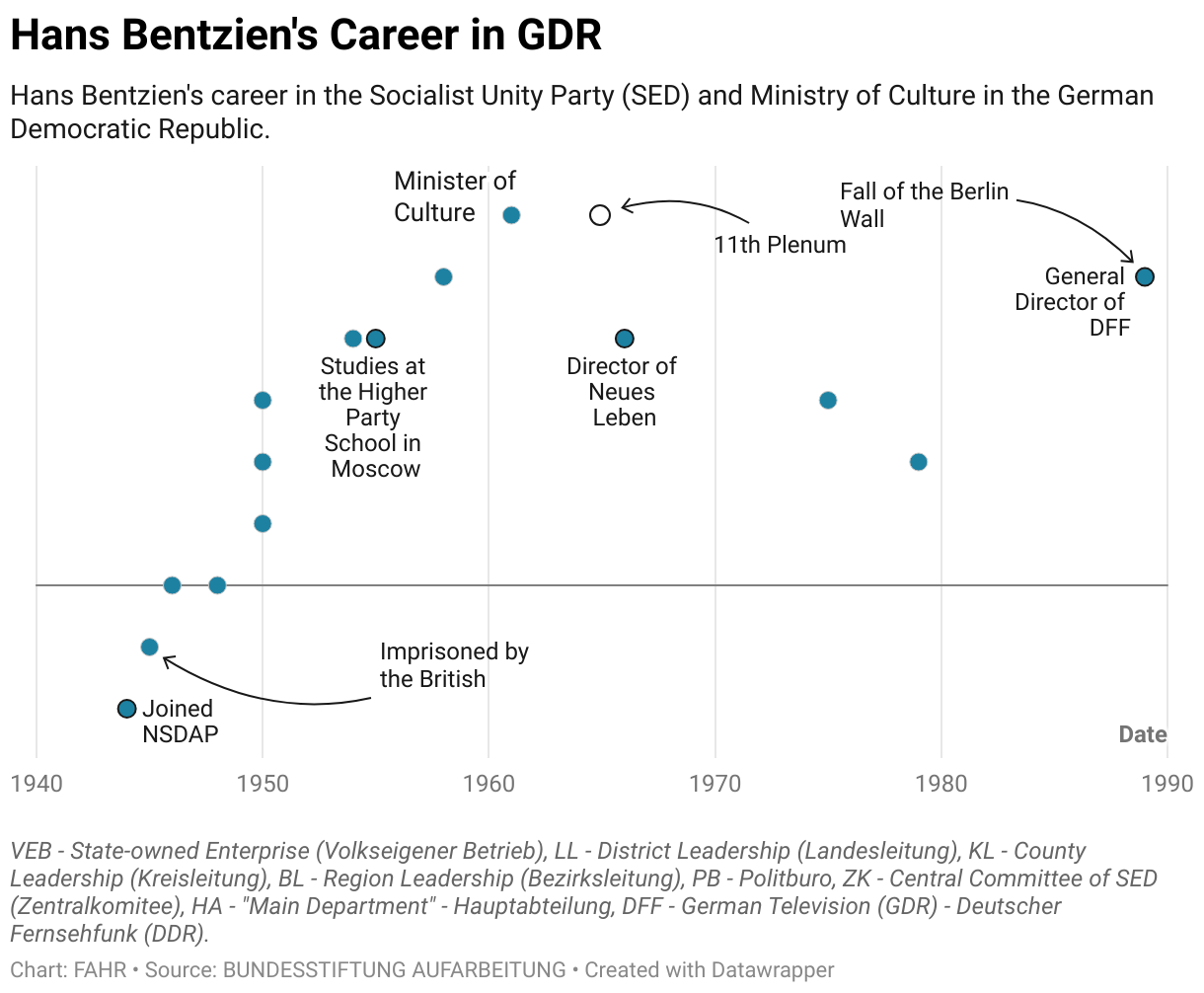
Here, it is shown how Bentzien’s career has developed over the course of GDR. You can see how the so-called “11th Plenum” serves a role of a turning point of his career. The full chart with all of his positions.
Start of the Political Career
He was released the same year and, in the year 1946, joined the Communist Party of Germany (KPD) and then, when it merged with the Socialist Democratic Party (SPD), the Socialist Party of Unity (SED). When joining the KPD, he informed local KL (“Kreis” (county) Leadership) secretary, Otto Sepke, of his NSDAP membership. Sepke, who experienced the imprisonment in the Buchenwald concentration camp, said that there is absolutely nothing special or bad in this situation. The county needed teachers and Bentzien found a job without any problems. He was a teacher in his hometown, Greifswald, from 1946 to 1948.
From 1948 to 1950, he was studying history at the Greifswald and Jena Universities. In parallel with that, he became a “temporary assistant to the culture director” of VEB (State/Publicly Owned Enterprise) Carl Zeiss Jena, a company creating optics. Same year, he started working in the SED-LL (“Landes” (district) Leadership) as “instructor for culture.” From this point, his career started growing really fast and he soon grew to the position of the 1st Secretary of KL of Jena-Stadt Kreis. In this position, in 1953 (age 26), he took some part in suppressing the June 17th revolts. There is no clear source describing his actions in detail, but right after the end of the protests, in 1954, he got promoted to the post of the Secretary for Culture and Public Education at the SED-BL (“Bezirks” (region) Leadership) of Gera Bezirks. He kept the position of the 1st Secretary of SED-KL.
From 1955 to 1958, he lived in Moscow, studying Social Sciences at the Higher Party School of the CPSU. After returning back to GDR, he continued to work as a Secretary for Culture and Public Education at SED-BL, but this time in Halle Bezirks.
Same year he assumed the position in Halle, he relocated to the Center and became a member of the Culture Commission at the Politburo (PB) of the Central Committee (ZK) of the SED as well
Minister of Culture – Reforms
By 1961, Walter Ulbricht, supported by Soviet Premier Nikita Khrushchev, initiated some economic and cultural reforms in the county. They involved promoting the younger generation of politicians in the government. Such people were Günter Witt (became Deputy Minister of Culture) and Jochen Mückenberger (head of DEFA film studio), who were all in their forties by that time. 34-year-old Bentzien was given the position of Minister of Culture, succeeding the reactionist Alexander Abusch, on February 27th, 19612. One of the liberal decisions that he made is the reduction of the DEFA’s dependence on the SED and central authority3. This new personnel set a goal of creating products that are not necessarily morally correct, following the Party’s line, but popular among the audience4. They argued for offering attractive products to the population and promoting the amateur freelance artists, who, as they were assuming, were to represent the ideas of the people and create those attractive products. This reformist approach was met with hostility from the old-school SED officials, who considered it to be traitorous to the revolutionary cause5. In this role, Bentzien also went into direct conflict with another powerful Party administrator and PB member, Paul Fröhlich. Fröhlich, backed by Ulbricht, had plans of destruction of the St. John’s Church in Leipzig. Bentzien, as Minister of Culture, spoke out against those plans. He believed that this action would go against the GDR’s Protection Act. By that moment the fact of his membership in the Nazi Party was already discovered by the Western press, which was harming the GDR’s reputation of an anti-fascist nation. This, combined with Ulbricht’s support of Fröhlich’s plan, did not allow Bentzien to prevent Fröhlich from blowing the Church up, which happened on May 9th, 19636.
11th Plenum – Downfall
Being part of the liberal wing went against the growing conservative forces, who were skeptical towards Ulbricht’s reforms. Thus, he was allowing the publication of certain discussions in the media that went against the official line of the Party and supported reforms in the organization led by then-leader of the GDR, Walter Ulbricht.
Although he was not one of the “Ulbricht’s men” in the office – he was not in a very good relationship with him – he was taken down as a result of the so-called “11th Plenum” of the ZK SED. At that Plenum, the whole cultural policy went “under fire” of criticism of the conservative wing7. Honecker accused the filmmakers of tendencies that were highly harmful to socialism. Bentzien got demoted for “serious mistakes” and “violating Party’s rules and directives,” together with other liberal forces (including Mückenberger and Witt) of the Party. They were all removed from their positions8. The Ministry was now given to the defiant and loyal communist, Klaus Gysi, who had frozen many processes started by Bentzien, including the one with DEFA, stopping the production and canceling many movie projects that went against the official line.
This constituted a high point of the cultural struggle within the Party. The conservative wing, fighting the liberalization, bourgeois skepticism, immorality, and anarchistic tendencies had prevailed.
From this moment, 39-year-old Bentzien started witnessing his own downfall: form 1966 to 1975, for almost 10 years, he led an important, but much less influential organization: the “Neues Leben” publishing house in Berlin. In 1975 he got demoted again. Now he became a Head of HA (“main department”) of Funkdramatik and Deputy Chairman of the State Committee for Television. Here, he continued not to follow the socialist line and canceled the weekly program “Der schwarze Kanal” (“The Black Channel,” black as “Western imperialism”). It was created in the 1960s, right after the Berlin Wall was constructed. Its purpose was to “counterbalance” the influence of the German media9. He also allowed two very controversial films (“Geschlossene Ges” and “Ursula”) to come out. These actions led to another demotion, and he ultimately started working as a head of the “working group” and as a regular author in the editorial journalism department of the DFF (Deutscher Fernsehfunk – German Television).
However, even after all those demotions and his fall into disgrace, he was not forgotten. From the very beginning of his political career he was quite active as a writer and, in 1985, he received a Theodor Körner Prize, for accomplishments in literature.
Honecker wanted to increase the historical legitimacy of the republic and, in some sense, turned to commemorating the monarchist times of German history (for example, in 1987, he ordered the reinstallation of the monument to the Prussian King Frederick II in Berlin). As a part of this project, he instructed Bentzien to get in touch with the Head of the Hohenzollern House in order to transport King Frederick’s remains and rebury them in the territory of GDR, where he used to reign. However, this idea did not end successfully, and the reburial happened only in 199110.
Another Rise
On November 22, a week after the fall of Berlin Wall, at the PB meeting, “directed to increase the responsibility of state media and its administrators for protecting the freedoms of journalists” it was decided to appoint Bentzien as a General Director of the DFF (German Television)11.
By that moment, the government and the whole republic was already collapsing. On November 7th, two days prior to the Fall of the Wall, the government of GDR resigned in its entirety. On November 9th, the law for free movement was passed, and the “germano-german” border was opened.
In December, at the extraordinary meeting of SED, the decision was made to abandon all “stalinist” structures and ideologies. SED was renamed into the “Party of Democratic Socialism” and the point determining the Party’s supreme role in German society was taken out from the constitution.
At the same time, the Council of Ministers of GDR made a decision of the dissolution of the Committees responsible for Radio and Television broadcasting. From this moment, Bentzien was not obligated to request any permissions from the Party and could operate fully independently. This led to the unprecedented cooperation between the media of FRG and GDR. Multiple agreements and projects began, including the creation of a documentary about the fall of GDR12.
Bentzien soon retired and worked as a freelance writer, occasionally giving some interviews about his past as a DDR official. He died peacefully in Bad Saarow, in 2015, at the age of 88, outliving many of his rivals.
Issue of Being a Nazi
He did inform the higher KPD authority, Otto Sepke, about his previous membership in the National Socialist Workers’ Party. Sepke was an old-fashioned communist leader, joining communist party in the 1930s, and was even a prisoner in Buchenwald. Sepke had approved his membership in KPD and told him that the country needs teachers and his past as a member of NSDAP was not going to be a problem. Sepke was in a position of authority and respect, representing the KPD’s policy towards NSDAP members. This policy was for sure quite forgivable and lenient towards those young men who joined the NSDAP in the sunset of the Third Reich (1944/1945) either forcibly or automatically (right after Hitler-Jugend), as it was a standard situation for any young man living in Germany and aging 17 or 18 years old by 1944/1945 and didn’t always mean his nationalistic views and beliefs.
However, in this case, Bentzien did show some deviation from the official party line, being part of the liberal wing and allowing cultural servants to make products that do not follow, and sometimes even contradict the Party’s policy and image. Nonetheless, this behavior should not be necessarily associated with his former membership in the NSDAP, as the Nazi party hierarchy was as strict or even more strict than the one of SED and by no means never would allow such situations to occur.
As for how this membership impacted his career, then the impact was definitely negative. When the first public news came from the “International Commission of Jurists,” based in West Germany in 1965,February 27th it negatively affected the whole reputation of the German Democratic Republic as of an anti-fascist state, because a member of the government (Bentzien was, by that time, a Minister of Culture) was an “ex-Nazi.” This fact, for sure, had contributed to the general discontent of his reformist methods, coming from the conservative faction of SED and specifically Erich Honecker, who was becoming more and more influential and ultimately took over the country in 197213.
- Burant, “East Germany : a Country Study,” 196. ↩︎
- Heiser-Meredith, “Kurt Maetzig’s Das Kanninchen bin ich: Lessons from a ‘Modern Dictatorship’ in East Germany?” ↩︎
- Wrage, “Berlin Chapter IV.” ↩︎
- Metz, “Zwischen Anpassung und Protest: Kino in der DDR.” ↩︎
- Waltz, “The Movement of Writing Workers in the German Democratic Republic: The Vision of Cultural Revolution and the Reality of Popular Participation.” ↩︎
- Jim Morton, “Private Party.” ↩︎
- Ernest, “‘Ein Staat der Jugend’: The Politics of Socialist Patriotism and National Consciousness in Shaping Youth Policy in the German Democratic Republic, 1961-1967.” ↩︎
- Metz, “Zwischen Anpassung und Protest: Kino in der DDR.” ↩︎
- Le Monde, “Une Longue Marche Vers la Démocratie.” ↩︎
- Bundeszentrale fur Politische Bildung, “Die Hohenzollern und die Demokratie nach 1918 (II).” ↩︎
- Nefyodov, “Agony of the SED’s Regime and the Cultural Processes in GDR (end of the 80s).” ↩︎
- Voronenkova, “Transformation of the Programmed Policy of the Audio-visional Media in East Germany During the Transitional Period of 1989-1993.” ↩︎
- Meenzen, “Konsequenter Antifaschismus? : Thüringische SED-Sekretäre Mit NSDAP-Vergangenheit.” ↩︎
 fahrsprojects.blog