

The Socialist Unity Party of Germany (Sozialistische Einheitspartei Deisutschlands – SED) was a Party established in the Post-World War II East Germany as a result of a merge between the Communist Party of Germany and the Socialist Democratic Party of Germany. The goal of this merge was to create a strong political force inside DDR1 that would practically occupy the power, obtaining a leading role in the government and the society in the DDR. What caused this policy was the CPSU’s2 policy of establishing complementary regimes in the allied countries, capable of enforcing the state interests of the USSR.
As the old Soviet saying states,
“During a phone call with Kremlin, the Warsaw Pact leader’s phone has only an earpiece – to hear the orders [but no mouthpiece, so there is no way to object].”
However, the main purpose of this page is to immerse the reader into some of the details in regards to the internal organizational structure of one such “regime” – the SED.
Elect and Command Structure of the SED
First, it is important to understand the central philosophy behind the formation of the Party. Similarly to its “older brother,” the CPSU, the SED was governed by the principle of the so-called “democratic centralism,” which, according to the SED Statutes3, means the “the election of bodies from the bottom to up and the implementation of decisions from the top to bottom.” Thus, each level of the Party hierarchy met at least twice every five years in the so-called Delegate Conferences (Delegiertenkonferenzen), having the following responsibilities:
- elect and confirm the corresponding leadership and the delegates for the next konferenz, on the higher level;
- discuss and present the current leadership’s reports about its work (financial, political, governing);
- make decisions on these reports;
- discuss the implementation of the political directives coming from the top.
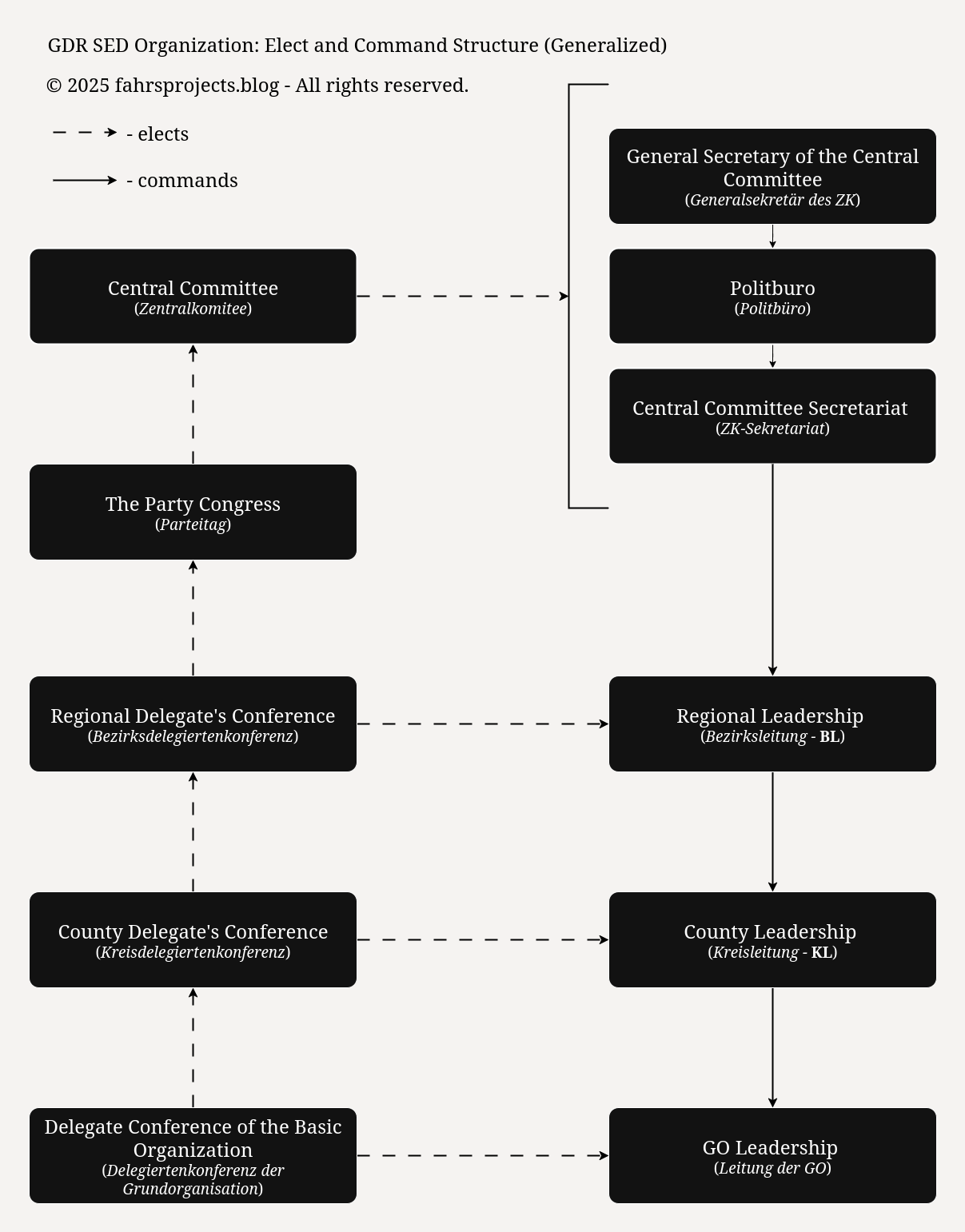
The example is the County Leadership (Kreisleitungen – KL), that was elected by the County Delegate’s Conference at least twice within a 5 year period, but this time by the special resolution of the Central Committee. County Delegate’s Conference was electing the party members who join the KL, but not the roles they have as part of the KL. KL members, generally consisting of 75 people, were usually deciding on the roles among themselves. The structure remains similar all the way to the Party Congress (Parteitag).
Command Structure: from Bottom to Top
From Party Group to Basic Organization
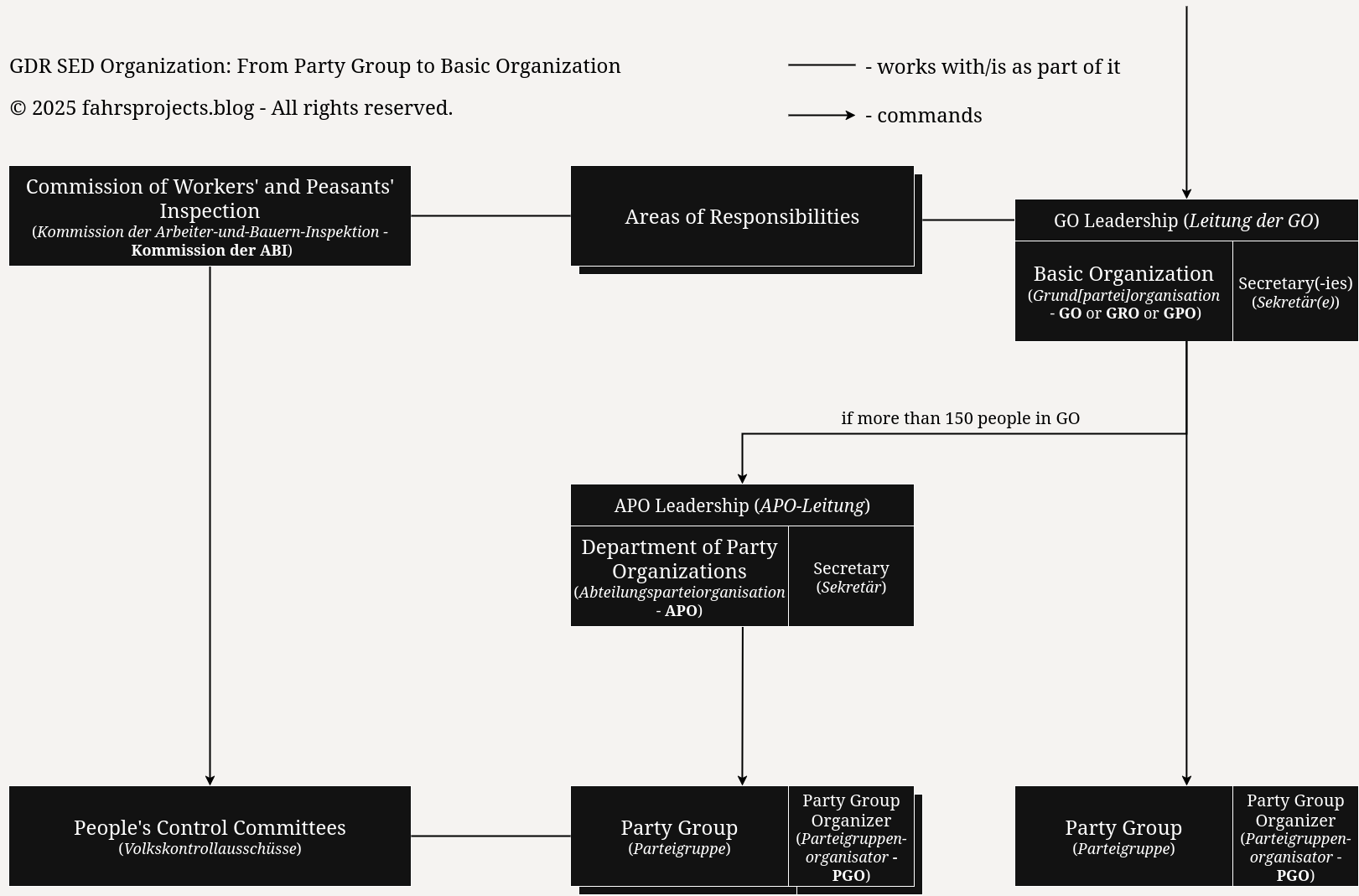
The central system and hierarchical structure of the SED were reflected at the district and county levels. The smallest unit of the SED was the Basic Organization (Grundorganisation – GO), which in turn was composed of Party Groups. The GO that was having more than 150 members was getting divided into the Departments of Party Organizations (Abteilungsparteiorganisationen – APO). If GO has fewer than 150 members, the Party Groups were directly subordinate to GO, without the APO in between.
Basic Organizations existed in two forms: as Work Party Organizations (Betriebsparteiorganisation – BPO) or as Residential Party Organizations (Wohnparteiorganisation – WPO), with BPO being dominant across GDR. Wherever people were professionally active, BPO was formed. Non-working people who spent most of their time at home were organized into WPO and were politically/organizationally active there.
- BPO included workplaces, universities, ministries, and other professional institutions.
- WPO were formed in residential areas, which included apartment complexes, streets, etc.
Such people as the FDJ secretary, ABI, and local labor union chairmen were always members of the GO Leadership. The elections were generally taking place annually, but sometimes could happen once in 2 years.
Members of the GO Leadership were getting assigned certain “areas of responsibilities,” depending on the specificity of the GO and its needs. Such areas could include:
- agitation and propaganda;
- cultural work;
- youth and sports;
- the activities of party members in the mass organizations of the National Front;
- military education/civil defense;
- collecting dues;
- conducting the party training of candidates for membership.
Workers’ and Peasants’ Inspection (Arbeiter-und-Bauern-Inspektion – ABI) was a special organization that was both a government and SED structure. Its goal was to monitor the execution of the ZK’s resolutions on all levels of the Party hierarchy. The leadership was appointed or removed by the Council of Ministers. The regional/county ABI administration was appointed by the local party leaderships. Although the organization was tightly connected to SED, their members did not have to be members of the SED; those were only the objectives and tasks that were decided by the Party, and not the composition of ABI’s members.
From Basic Organization to County Leadership
Central Party Organization
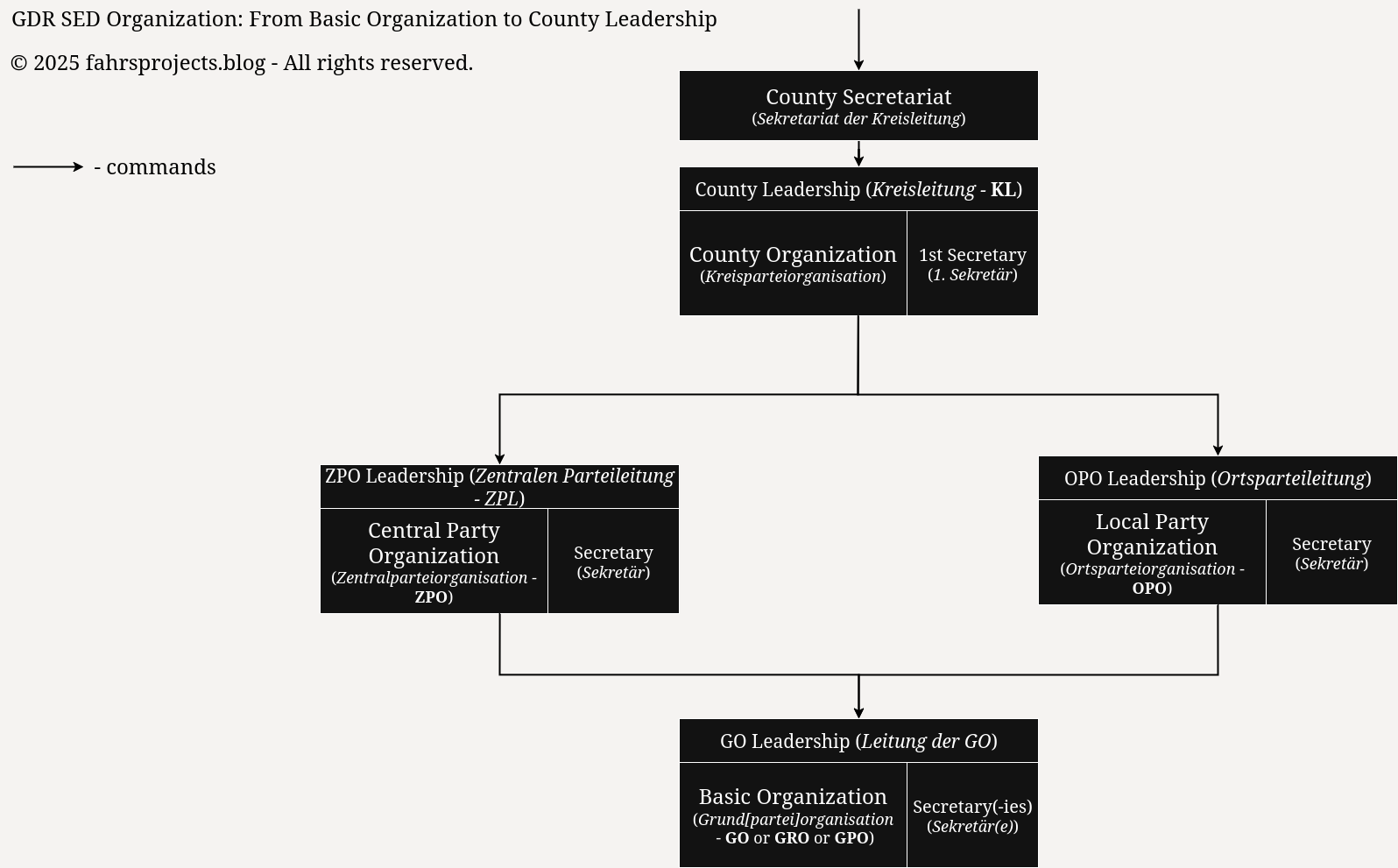
In particularly large communities, consisting of numerous individual companies, in medium-sized universities and colleges, as well as in the armed forces, several Basic Organizations were subordinate to a Central Party Leadership (Zentralen Parteileitung – ZPL), which was elected at a conference of delegates from their Basic Organizations.
Local Party Organization
Local Party Organization (Ortsparteiorganisation – OPO) were formed in small and medium-sized towns and communities where several GOs existed. The OPO was elected twice every five years at the OPO Delegate Conferences (Ortsdelegiertenkonferenzen).
Secretariats: From County to ZK
Starting from County Organization (Kreisparteiorganisation) each leadership was led by a Secretariat (Sekretariat). The Secretariat composition was quite similar on all levels of the SED structure.

Secretariat of any leadership was the most influential political institution in the Region/County of GDR.
It was usually meeting weekly, and often was running alongside the local Regional/County Council, constantly collaborating with the state government, overseeing and ensuring the completion of the Party resolutions. The 1st Secretary of the KL Secretariat (erster Sekretär der Kreisleitung) was also an additional member of the BL Secretariat.
Audit Commissions (Revisionskommissionen – RK) oversaw the use of the SED’s financial resources; particularly, they were collecting and accounting the party members’ dues (donations) to the Party. Overall, their responsibilities included financial audits of the party apparatus and party enterprises, and statistical evaluation of all that. County commissions consisted of minimum of three and maximum of fifteen members.
Party Control Commission (Parteikontrollkommission – PKK) had the tasks of fighting the enemies of the Party, corruption, abuse of office, careerists, “slander against leading comrades,” and investigating all offenses committed by the party members (party discipline). All PKK’s decisions required the correspondent leadership’s (leitung) approval. Those decisions included punishments, such as reprimand, severe reprimand, or even expulsion from the Party. All appeals were also going through PKK.
Leadership of the Party
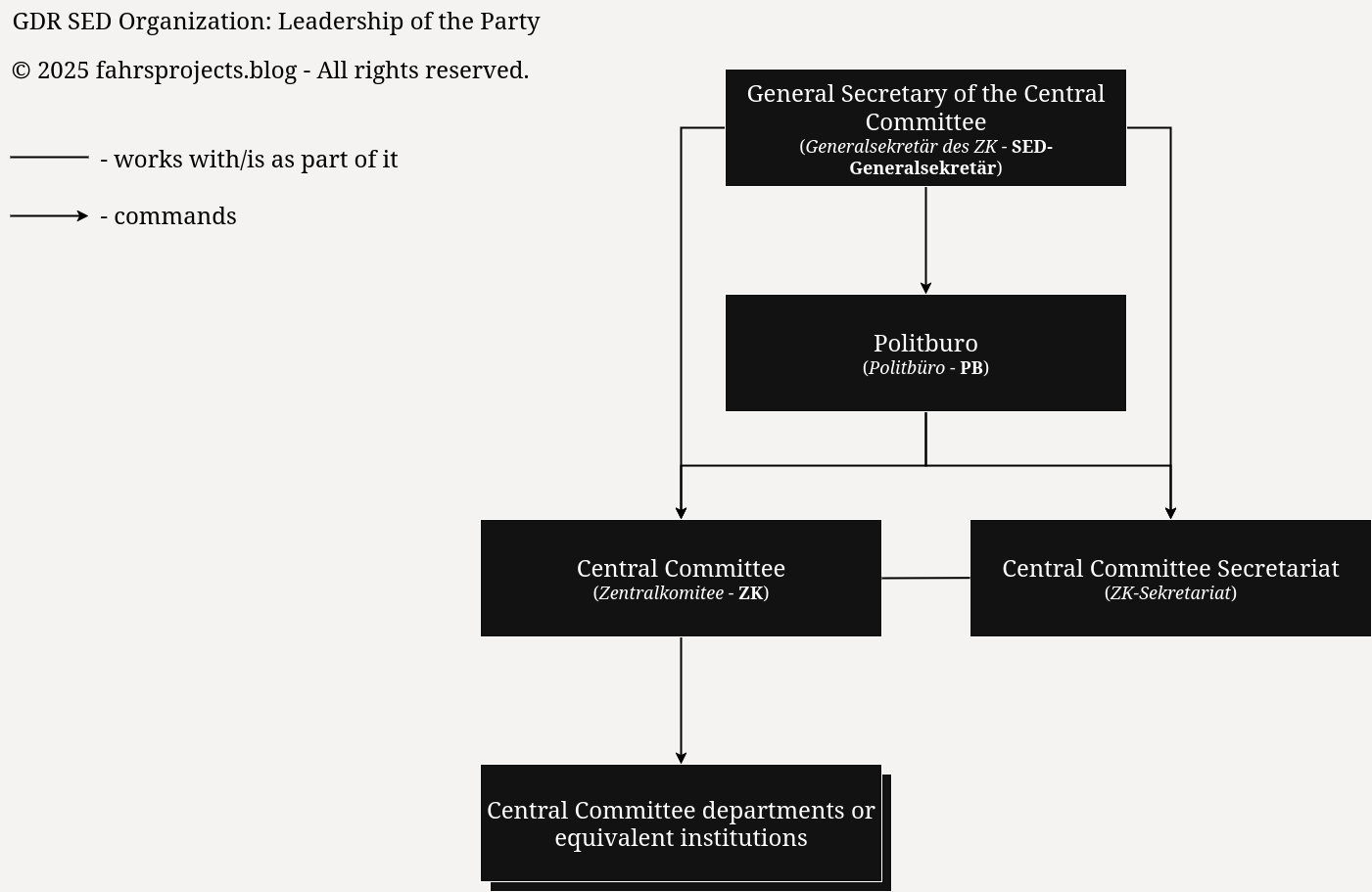
The Central Committee (Zentralkomitee – ZK) was responsible for directing all of the party’s activities in all areas of the East Germany’s statehood, through ~40 departments it had (i.e. Agriculture, Culture, “Health Policy,” and other, specifically Party-related ones, such as SED Cadres and “Friendly Parties [within GDR]”). ZK was confirming the heads of those departments. Besides departments, SED had special institutions it was overseeing; they included the editorial boards of the party press – newspapers, such as “Neues Deutschland” – that were broadcasting the SED’s news. The heads of ZK departments/institutions were tightly working together with the state ministers in the government of the GDR and supervising them.
The main function of the Central Committee Secretariat (ZK-Sekretariat) was to supervise the district and county leaderships, with the assistance from the Central Committee itself. Central Committee Secretariat was elected by the ZK, and was headed by the same person – the General Secretary of the ZK (Generalsekretär des ZK). However, the powers of the Secretariat were not actually defined in the SED Statute; Secretariat practically led the party apparatus and monitored the implementation of the PB’s resolutions throughout all levels of the party’s hierarchy.
The Politbüro (PB) of the SED Central Committee was the primary decision-making body of the Party and the country itself, deciding on the major policy questions. The Politbüro was sending the directives to the Council of Ministers (official state government). Moreover, those two organizations were often overlapping; thus, the Chairman of the Council of Ministers (head of government) from 1964 to 1973, Willi Stoph, was a member of PB as well. The Politbüro composition (as well as ZK Secretariat) was determined by the ZK, but not by choosing between specific individuals, but by approving the list from the previous term, sometimes making the individual changes (by removing, accepting resignation, or electing members). The size of the PB varied from 14 to 25 members, consisting of “full members,” members who had a right to vote; and “candidates”, who could only participate in discussions.
The General Secretary, sometimes First Secretary (Erster Sekretär), of the Central Committee was the highest authority in the German Democratic Republic. Besides being elected by the ZK, Generalsekretär was also always the chairman of Politbüro. ZK-Sekretariat, State Council – collective Head of State, – and National Defense Council, significantly distinguishing this position from any other high-ranking member of the Party. Numerous state and party officials were directly subordinate to him, making it possible for Generalsekretär to make decisions without directly involving either PB and/or ZK.
 fahrsprojects.blog